AI Pricing Decision Support GPT
Merchandize and Sales teams struggled to forecast the impact of price changes on whisky sales.
Built a custom GPT using financial data, historic forecasts, and pricing rules to guide decisions.
The use cases below are solutions built for Diageo brands—including Johnnie Walker, Guinness, and Baileys—to deliver measurable cost savings, time savings, or revenue growth. I believe that if an AI solution cannot claim at least one of these benefits, it is (often) a shiny object or a distraction.
Merchandize and Sales teams struggled to forecast the impact of price changes on whisky sales.
Built a custom GPT using financial data, historic forecasts, and pricing rules to guide decisions.
Johnnie Walker teams lacked clarity on incremental budget investment and faced slow agency support.
Created a bespoke GPT using 4 years of ROI data and media best practices to query optimal strategies.
Local brand teams spent vast sums of time and money adapting globally made assets for their market.
We onboarded a tool called Pencil, enabling teams to alter bottle shots and backgrounds at a fraction of the price and time, enabling faster campaign time.
Commercial teams produced inconsistent and non-competitive joint business plans with retailers.
Trained an AI agent in Microsoft Teams on historical data and best-in-class frameworks to generate first drafts.
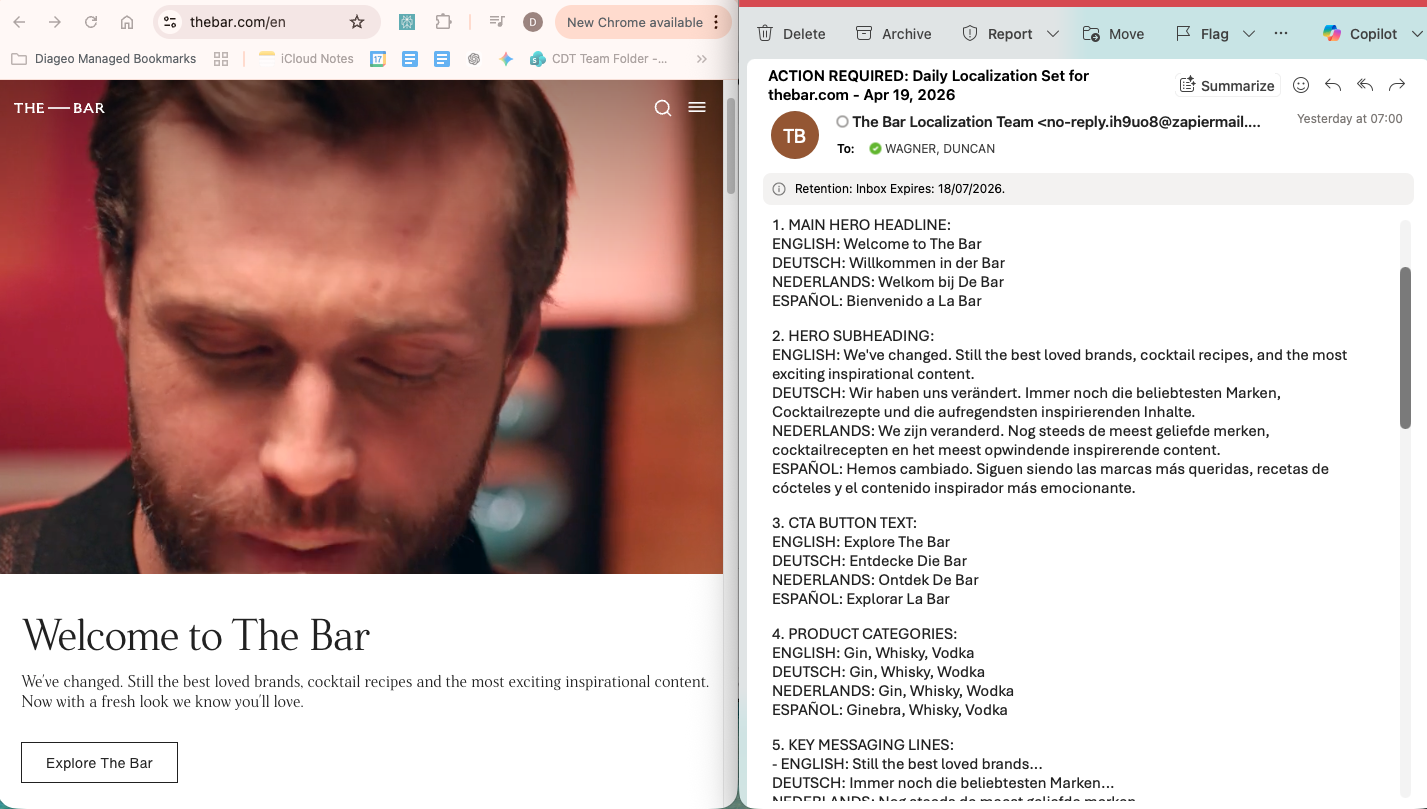
German, Spanish, and Dutch Ecommerce teams required frequent, manual translations for local websites.
Created a daily Zapier workflow that scrapes content, translates it via AI, and distributes it automatically.

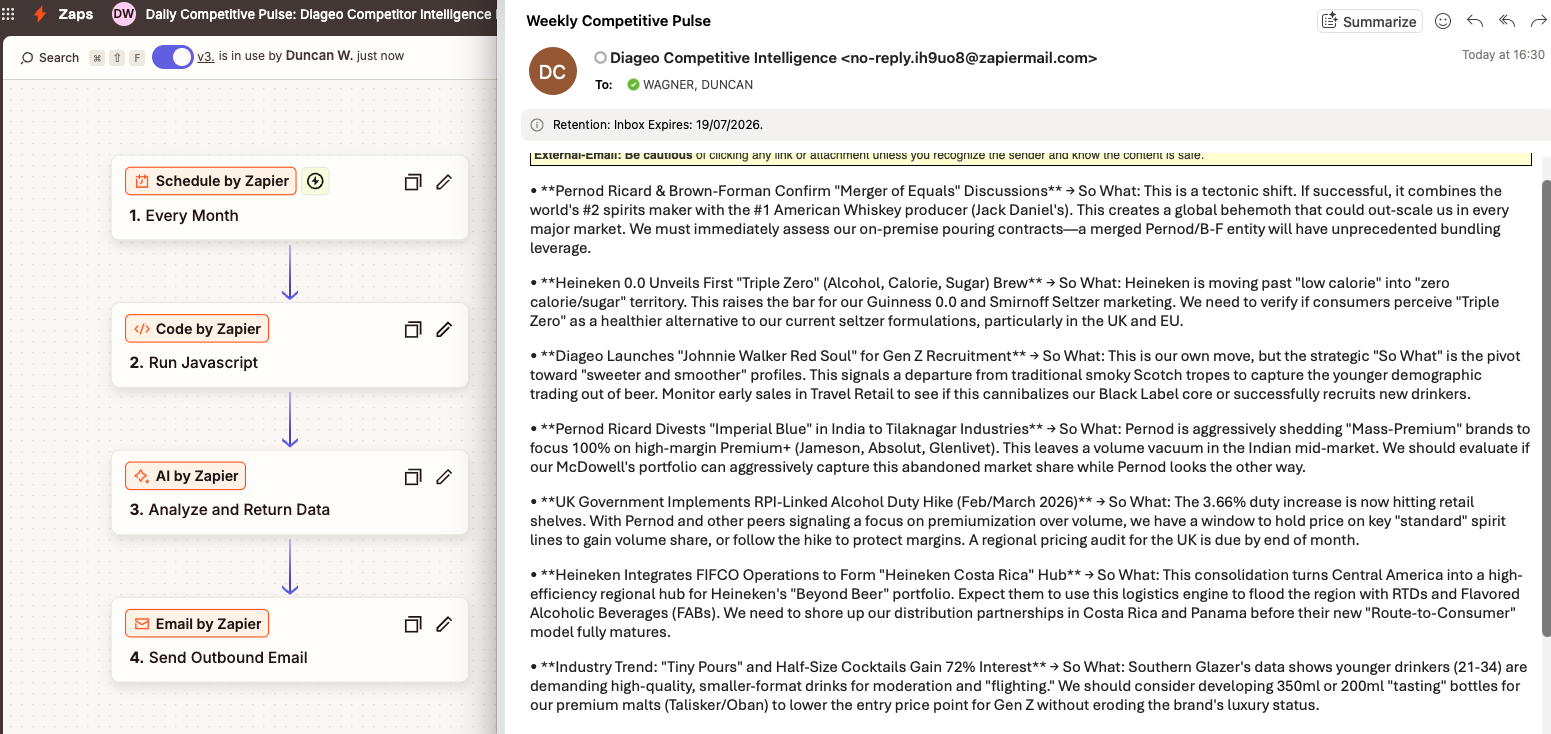
Leadership needed affordable and fast weekly summaries of competitor activity.
Designed a daily 9am automated email (Zapier) that analyzes competitor activity with “so what” summaries.

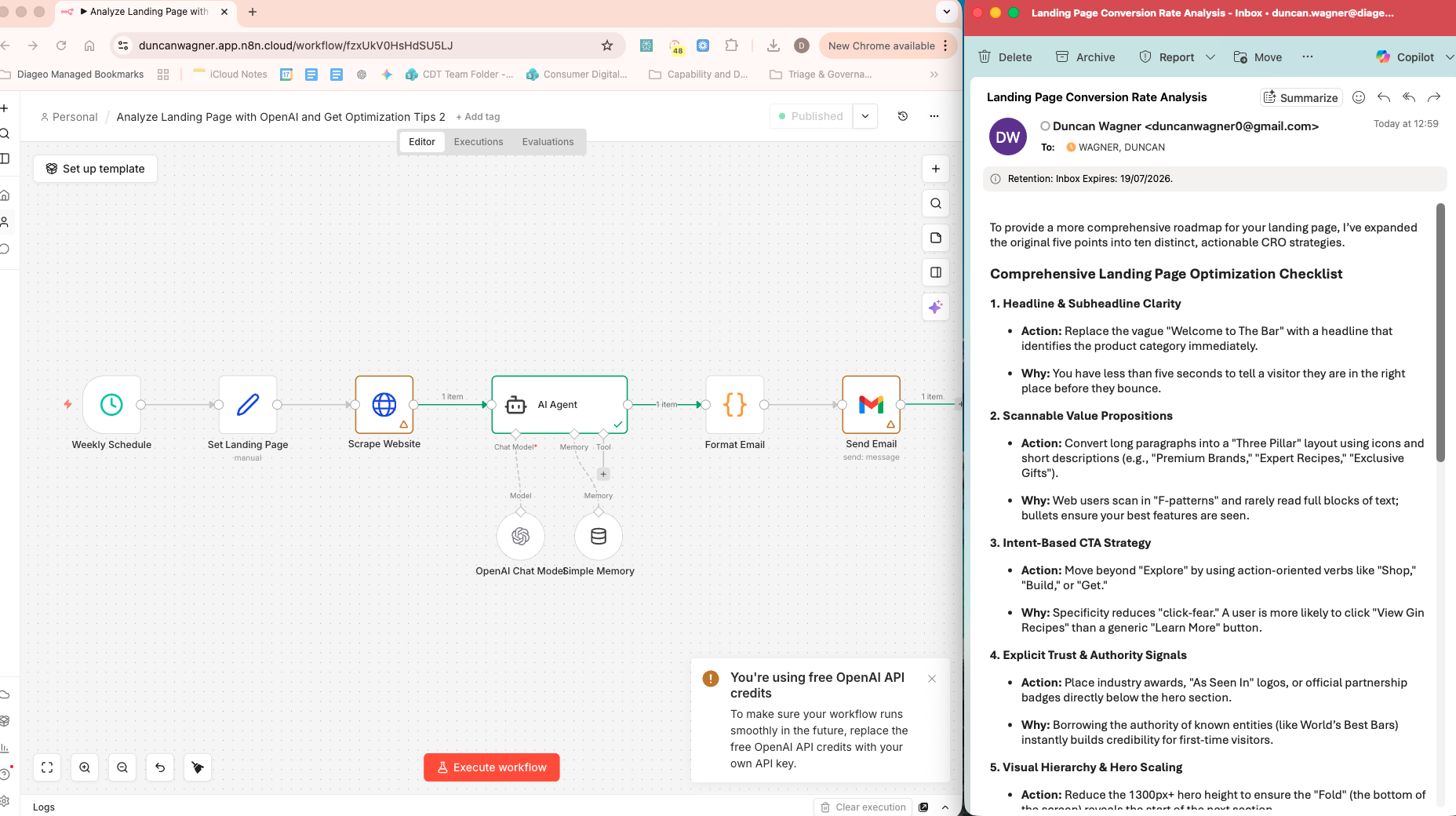
E-commerce in Europe relied on expensive and slow agency reports to improve the ranking of their thebar.com website.
Using n8n, we applied a tool that scraped the website on a monthly basis and offered 10 tangible, SEO-grade solutions for how to improve the site, which the team could apply directly.

Guinness teams were producing inconsistent and low-quality briefs for influencer agencies.
Enabled the creation of standardized, high-quality briefs incorporating all relevant data instantly.
Brand teams created adverts that violated the Marketing Code, leading to rework and delays.
Developed a Copilot chatbot to assess adverts against DMC standards with Red/Amber/Green feedback.
Employees spent excessive time on manual slide formatting instead of high-value analysis.
Built a templated Diageo format allowing Copilot to convert Word docs into polished presentations.
Teaching leaders, employees and teams about AI is difficult — here are some snapshots of how I've taught teams about the best way to approach AI in clear, easy to understand language.
A simple framework — Goal, Context, Expectations — for getting consistently useful answers from AI.
A three-step model — inventory, govern, and scale — to turn scattered AI activity into 5–10 high-impact, compliant use cases.
How AI value evolves over time — starting with cost and time savings, then unlocking revenue growth through ideation, ROI and acquisition.
Reframing the human/AI workflow: humans set the problem and polish, AI drafts the middle.
Why too much choice in AI tooling actually reduces execution — and how to find the sweet spot.
Explaining model bias in plain English — because we built and trained it.
Showing teams what an AI-augmented workday looks like — judgment and creativity, amplified.
Real-world examples of AI harm: bias, deception, backlash — and the bottom line for brands.
A practical framework for spotting risks across systems, prompts and outputs — with clear safeguards.
A practical checklist for evaluating AI vendors — with the 'good' vs 'bad' answers to listen for.